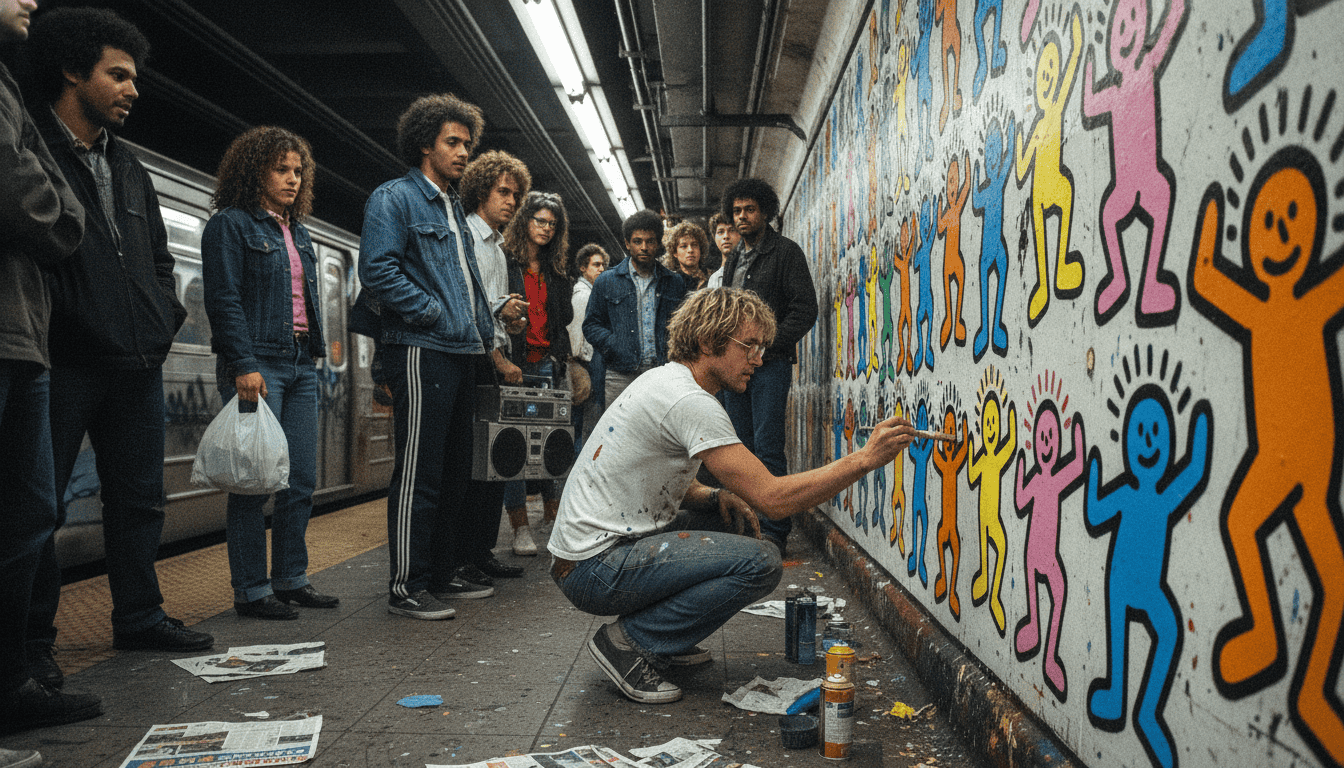
Keith Haring transformed the art world by refusing to confine creativity within gallery walls. His work exploded across New York City subway stations, public murals, and eventually onto canvases celebrated worldwide. Through bold lines and radiant figures, this artist created a visual language that spoke directly to people from every background.
Born in 1958, Haring rose from Pennsylvania’s suburbs to become one of the most influential artists of the twentieth century. His chalk drawings in subway stations captured the attention of millions of commuters. These spontaneous artworks became his signature, merging street culture with fine art traditions.
What made Keith Haring different was his commitment to accessibility. He believed art belonged to everyone, not just collectors and critics. This philosophy drove him to create public murals around the world and open his Pop Shop, where affordable merchandise brought his imagery into everyday life.
Beyond aesthetics, Haring used his platform for activism. He addressed urgent social issues including AIDS awareness, apartheid, and crack cocaine’s devastation of communities. His art became a weapon against injustice, combining visual power with political urgency during the 1980s.
This exploration reveals how one artist’s vision changed contemporary culture. We examine his early influences, breakthrough moments, major works, business innovations, and the legacy that continues inspiring new generations of artists and activists worldwide.
Early Life and Artistic Development in Pennsylvania
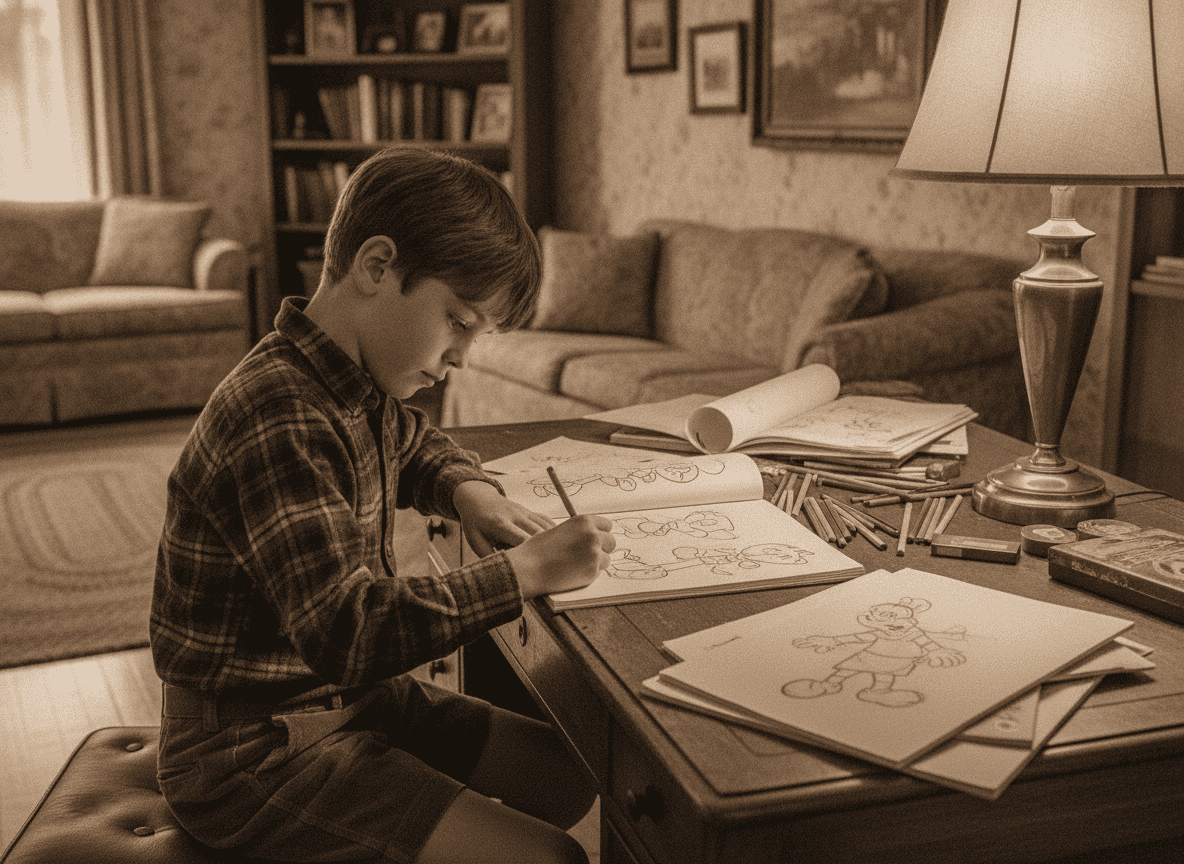
Keith Haring entered the world on May 4, 1958, in Reading, Pennsylvania. His family relocated to nearby Kutztown, a small town that shaped his formative years. His father, Allen Haring, worked as an engineer and amateur cartoonist who introduced young Keith to drawing’s fundamental joys.
The Haring household valued creativity. Keith’s father filled notebooks with cartoon characters, teaching his son basic techniques. This early exposure planted seeds that would later bloom into revolutionary artistic expression. The simple act of drawing together created a foundation for visual storytelling.
Childhood Artistic Influences
Television cartoons captured Keith’s imagination during the 1960s. He absorbed the visual language of mass media, studying how characters moved and stories unfolded through simple line drawings. Dr. Seuss books added another layer, demonstrating how whimsical illustrations could carry profound meaning.
His childhood drawings already displayed the energy that would define his mature work. He created characters constantly, filling pages with figures in motion. These early experiments taught him economy of line—how maximum impact could come from minimal marks.
Pittsburgh Art School and Early Experiments
After high school, Haring enrolled at Pittsburgh’s Ivy School of Professional Art in 1976. He initially pursued commercial art training, expecting to become a graphic designer. The structured curriculum felt limiting. He craved something beyond technical skill development.
Pittsburgh’s cultural scene opened new possibilities. He discovered Robert Henri’s book “The Art Spirit,” which championed authentic artistic expression over commercial constraints. This philosophy resonated deeply. Haring began questioning whether commercial art suited his emerging vision.
He experimented with various media during this period. Collage, painting, and conceptual installations all received attention. None felt entirely right. He sensed his true voice remained undiscovered, waiting for the right environment to emerge.
The Move to New York City
In 1978, Haring made the decisive move to New York City. He enrolled at the School of Visual Arts, immersing himself in Manhattan’s explosive art scene. The city’s energy matched his own—relentless, diverse, and unapologetically bold.
New York exposed him to artists who would become collaborators and friends. Jean-Michel Basquiat and Kenny Scharf shared his interest in breaking down barriers between high art and street culture. Together, they explored how art could exist outside traditional institutional frameworks.
The city’s subway system became his laboratory. He observed how people interacted with public space. Blank advertising panels covered in black paper appeared throughout stations. These empty surfaces called to him, presenting opportunities for unauthorized artistic intervention.
His education at the School of Visual Arts provided conceptual tools. Semiotics classes taught him how symbols communicate across cultural boundaries. Video art courses expanded his understanding of performance and documentation. These academic influences merged with street culture, creating the perfect conditions for breakthrough.
Subway Drawings and Rise to Fame in New York
Keith Haring discovered his defining medium in 1980 within New York City’s underground transit system. Empty advertising panels throughout subway stations, covered in matte black paper, became his canvas. These surfaces invited interaction. He responded with white chalk, creating what would become thousands of drawings over the next five years.
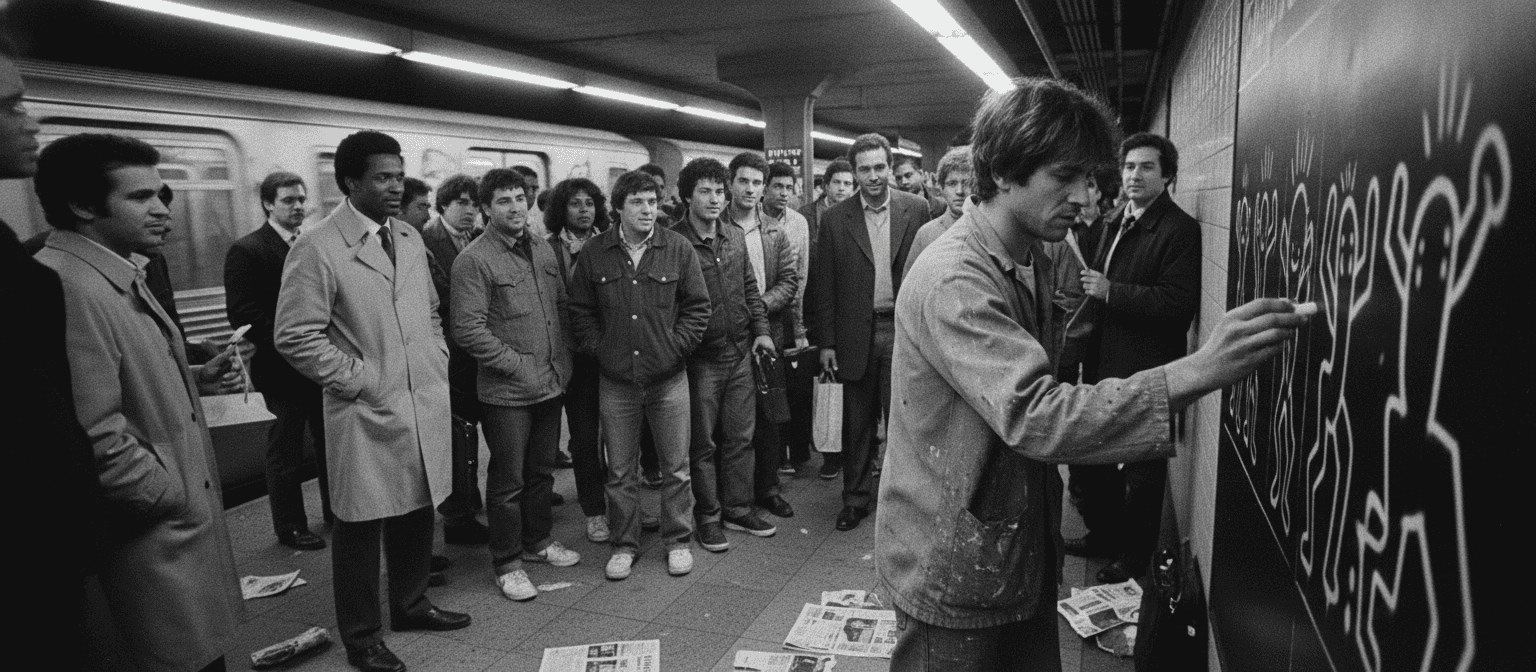
The subway drawings established direct communication with the public. Unlike gallery exhibitions requiring deliberate visits, his artwork confronted millions of commuters daily. People encountered his radiant babies, barking dogs, and dancing figures during their ordinary routines. Art became unavoidable, democratic, accessible.
The Technical Approach and Daily Practice
Haring worked quickly, often completing drawings in minutes between trains. Speed wasn’t just practical—it became central to his aesthetic. The rapid execution captured raw energy, preventing overthinking. Each drawing emerged spontaneously, responding to the moment’s creative impulse.
White chalk on black paper created maximum contrast. The medium demanded confidence. Unlike pencil or paint, chalk offers limited opportunities for correction. Every line had to count. This constraint pushed him toward bold, decisive mark-making that defined his visual vocabulary.
He produced several drawings daily, sometimes creating forty or more in a single week. This prolific output reflected both dedication and the work’s ephemeral nature. Transit authorities regularly removed the drawings, considering them vandalism. Haring accepted this impermanence. The work existed for moments, then vanished.
Developing a Universal Visual Language
The subway environment demanded immediate comprehension. Commuters had seconds to perceive and process images. This pressure refined Haring’s ability to communicate through instantly recognizable symbols. His figures stripped away unnecessary detail, distilling concepts to essential forms.
Recurring motifs emerged organically. The radiant baby symbolized innocence and potential. Barking dogs represented authority and aggression. Dancing figures celebrated life’s joy and movement. These symbols transcended language barriers, speaking directly to viewers regardless of background.
Haring’s subway work challenged traditional art distribution. Museums and galleries controlled access through admission fees and operating hours. The subway operated twenty-four hours, free to anyone with a token. This accessibility aligned with his democratic vision—art should reach everyone, not just privileged audiences.
Public Recognition and Media Attention
By 1982, Keith Haring’s subway drawings attracted significant media coverage. Newspapers documented this unusual phenomenon of unauthorized art in public transit. Photographers captured both his creative process and the crowds gathering to watch him work. The artist became inseparable from the work.
Commuters began recognizing him. Some waited at stations, hoping to witness new drawings appear. Others photographed the works, creating documentation that outlived the originals. This grassroots appreciation preceded institutional recognition, validating his approach to public engagement.
Gallery interest followed inevitably. His first solo exhibition at the Tony Shafrazi Gallery in 1982 attracted collectors and critics who’d encountered his work underground. The subway drawings had created an audience, proving that street art could generate serious artistic consideration without compromising accessibility.
Legal complications arose occasionally. Transit police arrested him several times for unauthorized drawing. He paid fines but never stopped creating. The risk was worth it. These confrontations actually enhanced his credibility within downtown art circles, where rebellion against institutional authority was respected.
Experience Haring’s Iconic Subway Aesthetic
Our studio specializes in reproducing Keith Haring’s bold line work and vibrant energy using museum-grade Giclée technology. We capture every detail of his revolutionary style—from the decisive chalk-on-black contrast to the radiant figures that defined a generation. Each reproduction honors his commitment to making powerful art accessible.
The Subway as Democratic Art Space
Haring frequently articulated his philosophy about public art. He believed the subway system represented New York’s true diversity better than any gallery. Businesspeople, students, workers, tourists—everyone used the trains. His art reached this authentic cross-section of humanity.
The works commented on contemporary issues. AIDS awareness, nuclear disarmament, and apartheid appeared in subway drawings alongside more playful imagery. Political content mixed freely with celebration, refusing to separate activism from aesthetics. This integration would characterize his entire career.
Other artists began emulating his approach, covering subway panels with their own unauthorized works. Haring welcomed this development. He never claimed ownership of the black panels. The subway became a gallery for emerging voices, democratizing not just art consumption but art creation itself.
His subway period lasted until 1985, when he gradually shifted focus to other projects. By then, he’d created an estimated five thousand drawings. Most were destroyed or painted over. Survivors occasionally appear at auction, fetching substantial prices—ironic given their origins in free public art.
Artistic Style and Visual Language
Keith Haring developed one of the twentieth century’s most immediately recognizable artistic styles. His visual vocabulary relied on bold black outlines, flat color fields, and energetic figures in constant motion. This approach emerged from multiple influences but cohered into something entirely original.
The Power of Line and Movement
Haring’s linework descended directly from cartooning traditions. Unlike traditional fine art’s emphasis on shading and modeling, he embraced the cartoon’s reductive clarity. Every figure existed as pure outline, filled with solid color or left as negative space. This simplified approach enabled rapid comprehension.
Movement radiated from his compositions. Figures danced, jumped, and gestured with explosive energy. Action lines—borrowed from comics—suggested motion and vibration. Nothing in a Haring work remained static. Even his backgrounds pulsed with visual rhythm.
The thick, consistent line quality became his signature. He avoided variation in line weight, maintaining uniform thickness throughout each drawing. This choice created graphic impact while reinforcing the work’s connection to commercial art and signage. His images could be read from distance, competing with advertising’s visual language.

Symbolic Vocabulary and Recurring Motifs
Certain symbols appeared throughout Haring’s work, forming a consistent iconographic system. The radiant baby—an infant surrounded by emanating lines—symbolized purity and potential. This figure became so associated with Haring that it now serves as his unofficial logo.
Barking dogs represented authority, aggression, and societal control. They appeared in political works addressing police brutality and government oppression. The three-eyed figure suggested expanded consciousness or surveillance, depending on context. These symbols could shift meaning based on surrounding elements.
Hearts, pyramids, dollar signs, and television sets populated his visual universe. Each carried specific connotations while remaining flexible enough for varied applications. This symbolic consistency allowed viewers to develop literacy in his visual language, deepening engagement with successive works.
Color Theory and Application
Haring employed color strategically. His palette favored primary hues—red, yellow, blue—along with vibrant secondaries. These pure colors maximized visual impact and referenced both Pop Art traditions and children’s art. The color choices felt joyful, accessible, and slightly aggressive.
He often worked with flat, unmodulated color fields. Figures received solid fills without gradient or texture. This approach reinforced the graphic quality while simplifying reproduction. His images translated easily across media, from murals to t-shirts, maintaining impact regardless of scale.
Black outlines remained constant across colored and monochromatic works. In subway drawings, white chalk on black paper reversed his typical color scheme while preserving the essential linear quality. This adaptability demonstrated how his style prioritized structure over specific color applications.
Influences and Artistic Lineage
Haring acknowledged debts to multiple sources. Pop artists like Andy Warhol and Roy Lichtenstein showed how commercial imagery could become fine art. Their elevation of lowbrow subjects validated his interest in cartoons and graffiti as legitimate artistic material.
Abstract Expressionism’s energy influenced his approach to composition and gesture. Jackson Pollock’s all-over compositions found echoes in Haring’s densely packed surfaces. He combined Pollock’s intensity with Pop Art’s accessibility, creating something that bridged supposed opposites.
Graffiti culture provided immediate context and community. Writers like Lee Quiñones and Fab 5 Freddy demonstrated how public space could become artistic territory. Haring absorbed graffiti’s boldness while developing a personal vocabulary distinct from letter-based tagging.
Children’s art informed his aesthetic more than most fine artists would admit. The directness, lack of self-consciousness, and pure expression he observed in kids’ drawings became models. He sought to maintain that unselfconscious energy while adding conceptual sophistication.
Horror Vacui and Compositional Density
Haring’s mature work displayed horror vacui—fear of empty space. He filled entire surfaces with figures, patterns, and symbols. This density created visual intensity, forcing viewers to scan compositions repeatedly, discovering new elements with each viewing.
The packed compositions reflected urban experience. New York City’s visual chaos—advertising, graffiti, signage all competing for attention—found parallel in his layered imagery. His work captured the city’s relentless stimulation through pictorial equivalents.
Despite surface complexity, individual elements remained clearly delineated. The thick outlines prevented figures from merging into indistinct masses. Each component retained identity while contributing to overall composition. This balance between density and clarity became characteristic.
His approach to space was fundamentally different from traditional Western art’s illusionistic depth. Haring created flat pictorial fields where all elements existed on the same plane. This rejection of perspective reinforced connections to graphic design, Egyptian art, and indigenous traditions prioritizing pattern over depth.
Major Works and Public Murals Around the World
Keith Haring extended his artistic practice beyond subway drawings to create monumental public murals across multiple continents. These large-scale works demonstrated his commitment to accessible art while addressing specific social and political issues. Each mural responded to its location and historical moment.
Crack is Wack: New York City Activism (1986)
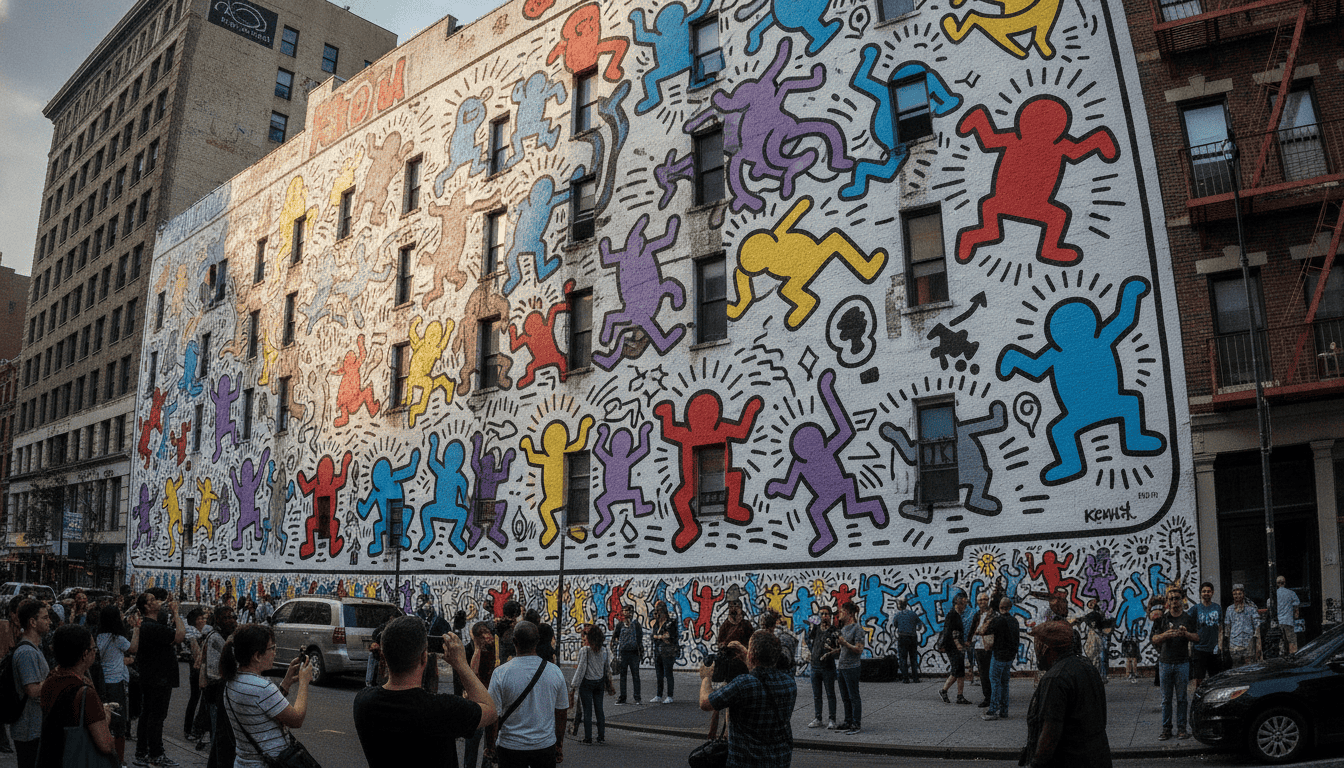
The “Crack is Wack” mural appeared in 1986 on a handball court wall in Harlem, New York. Haring created this work without authorization, responding to crack cocaine’s devastating impact on urban communities. The bold orange and red imagery depicted the drug’s destructive power through skull figures and chaotic compositions.
Initial reaction from authorities was negative. Police arrested Haring for vandalism. Public support proved overwhelming, however. Community members recognized the mural’s anti-drug message as beneficial. The city eventually officially preserved the work, acknowledging its social value.
The mural’s title became a catchphrase in anti-drug campaigns. Haring’s direct visual language communicated urgency without preaching. The work exemplified how street art could address serious social issues while maintaining aesthetic power. It remains protected today as a landmark.
Berlin Wall Mural: Symbolic Intervention (1986)
In 1986, Keith Haring painted a three-hundred-meter section of the Berlin Wall. This action occurred three years before the wall’s fall, when it still represented Cold War division. The mural depicted interlocking human figures in red and yellow, symbolizing unity across artificial barriers.
The work carried profound political meaning. By painting the Western side of the wall, Haring transformed a symbol of separation into an artistic statement advocating connection. The mural attracted international attention, photographed extensively and discussed in media worldwide.
When the Berlin Wall fell in 1989, Haring’s mural had already disappeared under layers of graffiti. Its ephemeral nature was intentional. The artist understood that public works exist in dialogue with their environments, subject to alteration and eventual destruction. Documentation preserved the gesture’s significance.
Tutti Frutti (1987)
This massive mural at The Center in New York City featured bright, joyful figures celebrating diversity and inclusion. Created for an LGBTQ+ community organization, the work expressed solidarity with a community facing AIDS crisis and discrimination.
We the Youth (1987)
Painted in Philadelphia, this mural addressed youth empowerment and education. Haring worked with local students, involving the community in creation. The piece demonstrated his belief that art-making could be collective and educational.
International Murals and Global Reach
Haring created murals in over a dozen countries during the 1980s. Each location received unique work responding to local context. In Paris, Amsterdam, Tokyo, Rio de Janeiro, and beyond, his distinctive style appeared on public walls, building international recognition.
The Pisa mural in Italy, titled “Tuttomondo” (All World), became one of his last major public works. Completed in 1989, the thirty-figure composition wrapped around a church exterior. The work celebrated universal humanity through his symbolic vocabulary, accessible to viewers regardless of language.
Australian murals addressed indigenous rights and environmental concerns. In Melbourne and Sydney, he collaborated with Aboriginal artists, learning from their traditions while contributing his own visual approach. These cross-cultural exchanges enriched both his practice and local art communities.
African murals appeared in countries including Kenya and Zimbabwe. These works often addressed health issues, particularly AIDS awareness. Haring used his growing fame to spotlight conditions affecting developing nations, demonstrating how art could amplify urgent messages.
Bring Haring’s Iconic Works Into Your Space
We meticulously reproduce Keith Haring’s most celebrated pieces using 12-color Giclée technology on 310 GSM archival cotton canvas. Our process captures the precise line work, vibrant energy, and bold color fields that made works like “Radiant Baby” and “Barking Dog” cultural touchstones. Each reproduction undergoes rigorous color-matching to museum standards.
Collaborations and Site-Specific Projects
Many murals involved collaboration with other artists and community members. Haring rejected the solitary genius model, preferring collective creation when appropriate. These partnerships produced hybrid works incorporating multiple styles and perspectives.
The “CityKids Speak on Liberty” mural in New York (1986) involved young people from diverse backgrounds. Students contributed ideas and helped paint, making the work genuinely collaborative. This approach reflected Haring’s educational philosophy—art should empower participants, not just instruct passive viewers.
His hospital murals brought art into healing environments. At Woodhull Medical Center in Brooklyn, he created vibrant works specifically for pediatric wards. The imagery aimed to comfort and distract young patients, demonstrating art’s therapeutic potential beyond galleries.
Documentation and Preservation Challenges
Public murals face inevitable deterioration. Weather, vandalism, and urban development threaten their survival. Haring understood this impermanence, often stating that public work’s value lay in its immediate impact rather than eternal preservation.
Photographs became crucial for documenting ephemeral works. Tseng Kwong Chi, a frequent collaborator, photographed many murals during and after creation. These images now serve as primary evidence of works that no longer exist physically.
Some murals have been deliberately preserved through restoration efforts. “Crack is Wack” receives periodic conservation to counteract environmental damage. The Keith Haring Foundation supports these efforts, recognizing certain works’ historical and cultural significance merits active protection.
Other murals have been lost completely. Buildings demolished, surfaces repainted, or natural deterioration erased them. This loss was anticipated. Haring’s democratic approach to art included acceptance that public works enter unpredictable lifecycles once released into the world.
Activism and Involvement in Social Causes
Keith Haring understood art as inseparable from social responsibility. Throughout his career, he leveraged growing fame to address urgent issues affecting marginalized communities. His activism wasn’t supplementary to artistic practice—it constituted a central component of his creative mission.
AIDS Awareness and Education
The AIDS crisis defined much of Haring’s later work and life. As the epidemic devastated New York’s gay community during the 1980s, he watched friends and collaborators die. His response combined artistic production with practical activism, creating works that educated audiences while destigmatizing the disease.
In 1988, Haring received his own AIDS diagnosis. Rather than retreating from public life, he intensified his activism. The “Ignorance = Fear” poster series directly addressed public misunderstanding about HIV transmission. Bold graphics and clear text delivered essential information in Haring’s accessible visual language.

He created artwork for ACT UP, the AIDS Coalition to Unleash Power, supporting their direct-action campaigns. These collaborations brought his imagery into street protests and awareness campaigns. Haring’s recognizable style amplified ACT UP’s visibility, attracting media attention to their demands for research funding and patient rights.
Safe sex education became another focus. His “Safe Sex” posters depicted condom use explicitly but tastefully, breaking taboos around discussing protection. These works appeared in clinics, community centers, and educational materials, reaching populations most affected by the epidemic.
Anti-Apartheid and Racial Justice
Haring opposed South African apartheid through both artwork and financial support. His “Free South Africa” prints raised funds for anti-apartheid organizations. The imagery depicted chains breaking and figures achieving liberation, translating political solidarity into visual form.
He participated in protests and benefit exhibitions supporting racial justice movements. These weren’t token gestures—he donated significant artwork and time. His commitment reflected genuine solidarity rather than opportunistic celebrity activism.
Collaborations with Black artists and activists deepened his understanding of systemic racism. Working alongside Jean-Michel Basquiat, he confronted art world’s racial hierarchies. Both artists challenged galleries and museums to recognize artists of color, using their platforms to advocate for institutional change.
Anti-Nuclear and Peace Advocacy
The nuclear arms race provoked strong reactions in Haring’s work. Images of mushroom clouds, radiation symbols, and threatened figures appeared frequently. He participated in peace rallies, creating protest banners and posters advocating disarmament.
His anti-nuclear imagery often depicted children threatened by atomic weapons. These works emphasized how military policies endangered future generations. The juxtaposition of his playful style with apocalyptic content created disturbing cognitive dissonance that enhanced messaging impact.
“Art is for everybody. I want to reach as many people as possible, especially those who normally wouldn’t enter galleries or museums. If my work can spread positive messages and support important causes, then it’s fulfilling its true purpose.”
LGBTQ+ Rights and Visibility
As an openly gay man, Haring created work celebrating queer identity and relationships. His imagery normalized same-sex love at a time when homophobia dominated mainstream culture. The visibility itself constituted activism—representation mattered profoundly.
He supported LGBTQ+ community organizations financially and artistically. The aforementioned “Tutti Frutti” mural for The Center exemplified this commitment. His Pop Shop donated proceeds from certain merchandise to queer causes, converting commercial success into direct support.
The intersection of AIDS activism and LGBTQ+ advocacy was inevitable. Haring understood that homophobia exacerbated the health crisis, as politicians ignored AIDS due to its association with gay communities. His work addressed both issues simultaneously, refusing to separate public health from civil rights.
Youth Empowerment and Education
Haring believed young people possessed natural creativity that society often suppressed. He conducted workshops in schools, community centers, and hospitals, encouraging children to create without self-censorship. These sessions valued process over product, emphasizing art’s therapeutic and expressive potential.
His collaborations with youth organizations produced murals and projects involving direct participation. Students weren’t passive recipients of his wisdom—they contributed ideas and labor. This approach democratized artistic authority, challenging hierarchies between professional artists and amateur creators.
Educational materials incorporating his imagery reached classrooms worldwide. Teachers used his accessible style to discuss complex topics from diversity to environmental protection. The visual clarity made challenging concepts comprehensible for young audiences.
Drug Abuse Prevention
The previously mentioned “Crack is Wack” mural inaugurated ongoing anti-drug work. Haring witnessed crack cocaine’s devastation in New York neighborhoods. His response combined visceral imagery with clear messaging, creating awareness tools for communities in crisis.
He partnered with anti-drug organizations, contributing artwork to campaigns targeting youth. The materials avoided preachy moralizing, instead presenting factual information about addiction’s consequences. His credibility with young audiences made these efforts particularly effective.
Unlike some celebrity anti-drug campaigns, Haring’s work emerged from genuine community concern rather than publicity seeking. He saw connections between drug policy, poverty, and systemic racism, addressing root causes alongside immediate symptoms.
Collaborations with Artists and Celebrities
Keith Haring thrived within collaborative networks that defined 1980s New York’s creative explosion. His partnerships with fellow artists, musicians, dancers, and cultural figures produced innovative cross-disciplinary work while expanding contemporary art’s boundaries.
Jean-Michel Basquiat: Parallel Trajectories
Jean-Michel Basquiat and Keith Haring shared profound artistic kinship. Both emerged from New York’s street art scene, achieved rapid gallery success, and addressed social issues through their work. Their friendship was genuine, built on mutual respect and shared experiences navigating the art world as outsiders.
They occasionally collaborated on works combining Basquiat’s neo-expressionist intensity with Haring’s graphic clarity. These pieces demonstrated how different approaches could coexist productively. More importantly, their public friendship challenged art world’s tendency to pit successful young artists against each other competitively.
Basquiat’s death in 1988 devastated Haring. He created memorial works honoring his friend while publicly criticizing the art establishment’s exploitation of Basquiat’s talent. This grief and anger intensified Haring’s own awareness of mortality as he faced AIDS diagnosis.
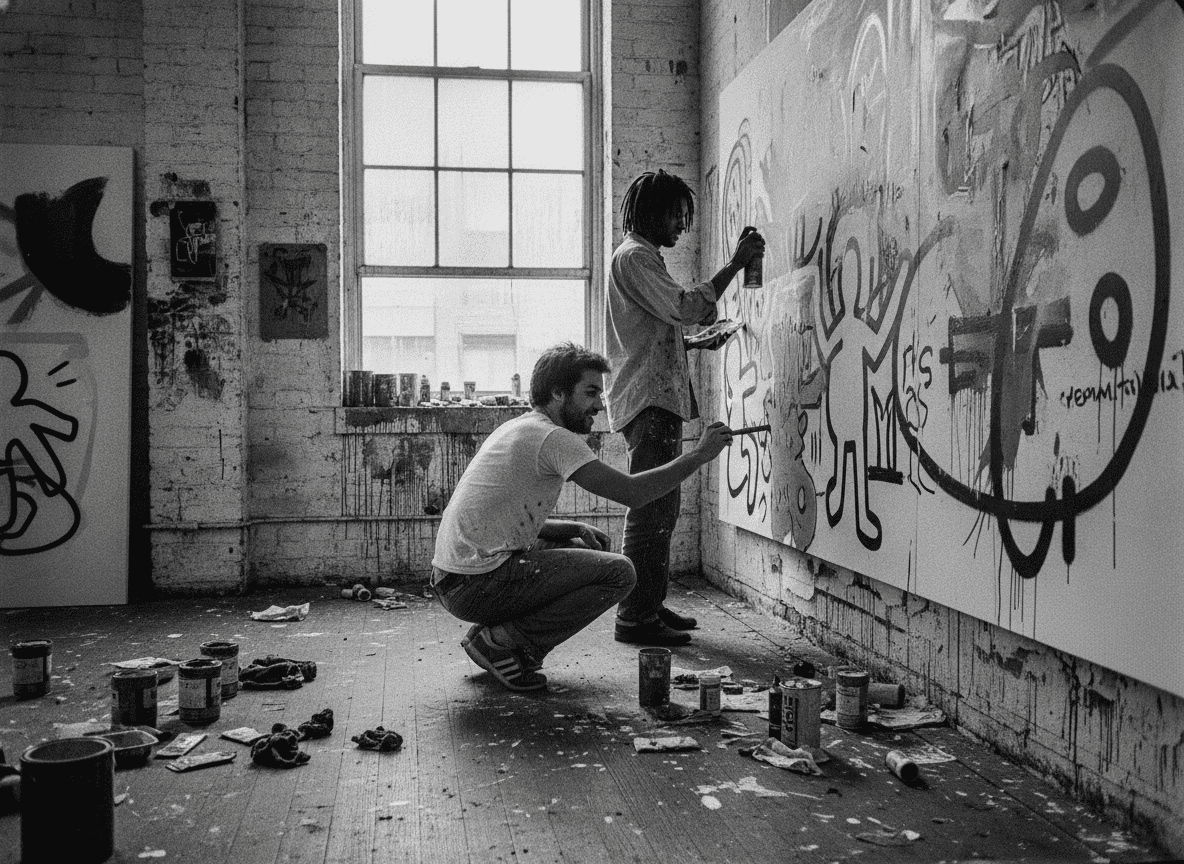
Andy Warhol: Mentor and Contemporary
Andy Warhol recognized Haring’s talent early, providing encouragement and opportunities. Their relationship transcended simple mentorship—Warhol appeared genuinely intrigued by Haring’s approach to public art and commercial accessibility. Both artists questioned boundaries between fine art and popular culture.
They collaborated on several projects, including MTV promotional materials. Warhol’s influence reinforced Haring’s comfort with commercial work. If the Pope of Pop Art saw no contradiction between artistic integrity and merchandise, Haring felt justified pursuing similar paths.
Warhol’s sudden death in 1987 shocked Haring. He created tribute works and participated in memorial exhibitions. The loss contributed to Haring’s sense of urgency—three central figures in his artistic circle (Warhol, Basquiat, and later himself) would all die young, within a compressed timeframe.
Grace Jones: Performance Art Fusion
Musician and performer Grace Jones became one of Haring’s most visible collaborators. He painted directly on her body for performances and photo shoots, transforming her into living artwork. These collaborations merged painting, performance, photography, and music into total artistic experiences.
The body painting sessions produced iconic images. Jones’s powerful physical presence combined with Haring’s bold patterns created visually striking results. Photographer Robert Mapplethorpe documented some sessions, creating photographic artworks in their own right.
These collaborations challenged conventional medium boundaries. Was the painted body sculpture, performance, or painting? The ambiguity was intentional. Haring sought to dissolve categories separating artistic disciplines, embracing hybrid forms that resisted easy classification.
Jones’s performances featuring Haring’s body paint reached audiences beyond galleries. Music videos and concerts exposed millions to his imagery in contexts divorced from traditional art presentation. This mass visibility aligned with his democratic artistic philosophy.
Kenny Scharf and the East Village Scene
Kenny Scharf shared studio space with Haring at the School of Visual Arts. Their friendship preceded fame, built on genuine artistic affinity. Both artists embraced cartoon influences and street culture, developing parallel but distinct visual vocabularies.
They participated in group exhibitions that defined East Village gallery scene. These shows created alternative art economy outside established uptown galleries. The casual, inclusive atmosphere encouraged experimentation and collaboration.
Scharf and Haring supported each other’s work publicly, appearing at exhibitions and promoting each other’s projects. This mutual support modeled collaborative rather than competitive artistic relationships. Their friendship endured throughout Haring’s life.
Madonna: Pop Culture Integration
Keith Haring designed album covers and promotional materials for Madonna during her early career. Their collaboration reflected shared interests in challenging sexual taboos and celebrating popular culture. Both artists understood how to manipulate mass media for artistic and commercial purposes.
The partnership was mutually beneficial. Madonna gained cutting-edge visual identity from Haring’s distinctive style. Haring accessed massive popular audience through her music industry platform. Neither saw this exchange as compromising—both embraced pop culture as legitimate artistic territory.
William S. Burroughs: Literary Connections
Beat Generation writer William S. Burroughs collaborated with Haring on several projects. Their work together bridged different artistic generations and mediums. Haring created visual responses to Burroughs’s texts, illustrating the writer’s dystopian visions.
The collaboration demonstrated Haring’s intellectual range. Critics sometimes dismissed his accessible style as superficial. Working with a respected literary figure validated his conceptual sophistication while introducing his work to literary audiences.
Timothy Leary: Consciousness Exploration
Psychedelic advocate Timothy Leary and Haring shared interests in expanded consciousness and technology’s potential. They collaborated on digital art projects and discussed art’s role in social transformation. These conversations influenced Haring’s later work with computers.
Their partnership attracted criticism from those viewing Leary as problematic. Haring defended the collaboration, arguing that Leary’s ideas about consciousness expansion aligned with art’s transformative potential. He valued intellectual exchange over respectable associations.
Haring’s collaborative approach reflected genuine belief in collective creativity. Unlike artists guarding individual genius, he shared credit generously and sought opportunities to merge his practice with others’. This openness produced diverse work while building supportive community networks that sustained him personally and professionally.
Pop Shop and Commercial Ventures
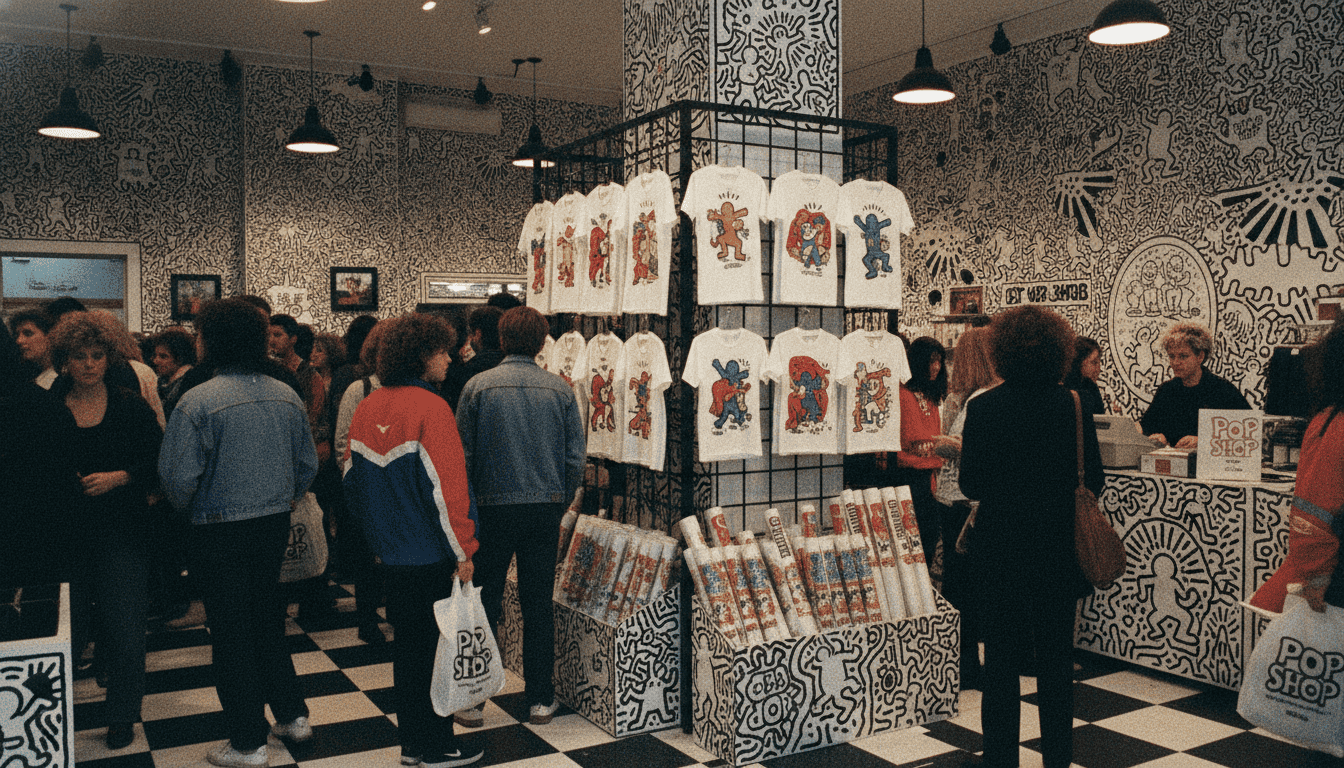
In 1986, Keith Haring opened the Pop Shop in Manhattan’s SoHo neighborhood. This retail store sold affordable merchandise featuring his imagery—t-shirts, posters, toys, and various products accessible to average consumers. The venture provoked controversy within art world circles while perfectly expressing Haring’s democratic artistic vision.
The Philosophy Behind Pop Shop
Haring conceived the Pop Shop as extension of his public art philosophy. If subway drawings brought art to commuters, the shop brought art into daily life through functional objects. He wanted people wearing, using, and living with his imagery, not just viewing it in galleries.
The venture directly challenged art world hierarchies. Traditional thinking positioned affordable merchandise as inferior to unique gallery works. Haring rejected this snobbery. He believed a child wearing a Haring t-shirt experienced legitimate artistic engagement, potentially more meaningful than wealthy collectors viewing paintings.
Critics accused him of selling out. Some saw the Pop Shop as crass commercialism contradicting his activist credentials. Haring countered that accessibility required affordable price points. Original paintings cost thousands—t-shirts cost twenty dollars. The shop democratized ownership in ways galleries never could.
Merchandise and Product Design
Pop Shop inventory reflected Haring’s playful sensibility. Beyond clothing and posters, the store offered toys, buttons, magnets, and various objects integrating his imagery into everyday life. Each product was carefully designed, maintaining aesthetic standards rather than slapping images onto generic goods.
The merchandise quality exceeded typical commercial reproductions. Haring supervised production, ensuring colors matched his specifications and materials met durability standards. He understood that poor-quality products would undermine the entire concept—people needed to value and keep these objects.
Prices remained deliberately affordable. While he could have commanded premium pricing based on his gallery success, he kept Pop Shop costs accessible to young people and working-class customers. Profitability mattered less than distribution—getting artwork into maximum hands.
Design and Store Aesthetic
The Pop Shop itself functioned as art installation. Haring covered walls, floor, and ceiling with his black-and-white patterns. Entering the store meant immersion in his visual universe. The environment demonstrated total design integration, erasing boundaries between art object and architectural space.
The store’s visual intensity attracted tourists and art enthusiasts alongside regular shoppers. People visited as much to experience the space as to purchase merchandise. This dual function—retail operation and artistic environment—exemplified Haring’s refusal of categorical divisions.
Staff wore Haring-designed uniforms, further integrating human presence into the overall aesthetic. Every element received attention, creating cohesive experience from sidewalk entrance through purchase transaction.
- Museum-grade Giclée printing with 12-color precision
- Archival-rated materials with 100+ year lightfastness
- 310 GSM cotton-blend canvas with tactile texture
- Hand-stretched gallery wrapping with acid-free backing
- UV-resistant inks preventing color degradation
- Certificate of authenticity with edition documentation
- Meticulous color matching to original artwork standards
- Investment-grade pieces maintaining value over time
Gallery-Quality Studio Reproductions
- Offset printing with limited color gamut accuracy
- Standard paper stock prone to yellowing and fading
- Flat surface without canvas texture or depth
- No mounting options, requires separate framing costs
- Non-archival inks that deteriorate under light exposure
- No documentation or authenticity verification
- Generic color reproduction often shifting from originals
- Disposable quality with minimal longevity or resale value
Mass-Market Poster Production
Honor Haring’s Democratization Mission with Quality
Keith Haring believed art should reach everyone—but accessibility doesn’t require sacrificing quality. Our studio bridges the gap between unaffordable originals and disposable posters, offering museum-grade reproductions at prices that respect both Haring’s democratic vision and your home’s aesthetic standards. We use the same archival materials found in major institutions, ensuring your Haring reproduction becomes an heirloom piece rather than temporary decoration.
Economic Model and Sustainability
The Pop Shop operated successfully throughout Haring’s lifetime. Contrary to expectations that novelty would fade, demand remained consistent. Tourists visiting New York included the shop in their itineraries. Local supporters bought items regularly as gifts or personal use.
Haring donated significant portions of Pop Shop proceeds to charities. The venture wasn’t purely profit-driven. AIDS organizations, youth programs, and activist groups received funding generated by merchandise sales. This structure transformed shopping into indirect activism—purchases supported causes.
After Haring’s death in 1990, the Pop Shop continued operating for several years. His estate maintained the store as both memorial and ongoing business. A second location opened in Tokyo, extending the concept internationally. Both eventually closed, but they’d proven the viability of artist-operated retail challenging gallery monopoly on art distribution.
Legacy and Influence on Artist Entrepreneurship
The Pop Shop model influenced subsequent generations of artists. It demonstrated that artists could control distribution and pricing, bypassing galleries when desired. This independence previewed current direct-to-consumer models enabled by internet technology.
Contemporary street artists like Shepard Fairey and KAWS have adopted similar approaches, selling affordable merchandise alongside limited editions. The strategy validates Haring’s insight that commercial accessibility and artistic integrity aren’t contradictory.
Art world attitudes have shifted since the 1980s. What seemed controversial then—artists operating retail businesses—now appears prescient. Haring anticipated how artists would need entrepreneurial skills to sustain practices outside traditional institutional support.
Licensing and Brand Management
Beyond the Pop Shop, Haring licensed his imagery for various commercial applications. Watch designs, skateboard graphics, and other products featured his work. He maintained creative control, approving all licensed uses to ensure quality and appropriate context.
Some licensing deals attracted criticism similar to Pop Shop complaints. Haring remained unperturbed. He saw licensing as expanding his imagery’s reach, introducing his work to audiences who’d never visit galleries. The commercial applications served his ultimate goal—maximum visibility and accessibility.
The Keith Haring Foundation now manages his estate, continuing selective licensing while supporting charitable causes. The foundation balances commercial opportunities with protecting Haring’s artistic legacy and activist commitments. This stewardship ensures his work remains accessible while preventing exploitation.
Embracing Technology and Digital Innovation
Keith Haring maintained consistent interest in technology’s artistic potential throughout his career. Unlike some contemporaries viewing digital tools skeptically, he embraced emerging technologies as new media for creative expression. This forward-thinking approach produced pioneering work in digital art and animation.
Early Computer Art Experiments
In 1983, Haring began experimenting with computer graphics at New York Institute of Technology. The primitive software and limited hardware available seemed restrictive compared to traditional media. He persevered, intrigued by digital creation’s unique possibilities.
His early digital works adapted his linear style to pixel-based constraints. The computer forced him to think differently about composition and color. Rather than viewing limitations as problems, he explored how digital tools could generate new aesthetic effects impossible in painting or drawing.
These experiments remained largely private during his lifetime. He didn’t consider early digital pieces fully realized works. They represented research—investigating how technology might transform artistic practice in coming decades. His instincts proved correct as digital art eventually revolutionized creative production.
Collaboration with Computers
Haring viewed computers as collaborative tools rather than mere instruments. He spoke about “collaborating with the machine,” acknowledging how software algorithms influenced creative decisions. This perspective anticipated current discussions about AI and computational creativity.
He created animations using early computer graphics programs. These moving images extended his interest in motion and energy beyond static compositions. The animations often featured his signature figures dancing and transforming, bringing his line work into temporal dimension.

MTV and Mass Media Innovation
Haring created animated station identification segments for MTV during the network’s early years. These short animations introduced his work to millions of television viewers. The exposure dwarfed anything possible through gallery exhibitions alone.
The MTV animations demonstrated perfect synergy between Haring’s aesthetic and music video culture. His bold graphics and rhythmic compositions suited the medium ideally. Young viewers absorbed his imagery alongside their favorite music, creating associations between Haring and youth culture.
This mass media work attracted predictable criticism. Art world purists saw television as commercial degradation. Haring countered that reaching millions through TV fulfilled his democratic mission better than reaching thousands through museums. The argument reflected larger debates about art’s relationship to popular culture.
Interactive Installations
Later in his career, Haring created interactive installations incorporating technology. These works invited audience participation, using sensors and responsive systems. Viewers’ movements would trigger visual or audio changes, making them co-creators of temporary experiences.
The interactive pieces reflected his belief in art as dialogue rather than monologue. Traditional paintings addressed passive viewers. Interactive works required active engagement. This shift anticipated participatory art practices that would dominate subsequent decades.
Documentation and Archiving
Haring understood documentation’s importance for ephemeral work. He extensively photographed and videotaped his creative process. This documentation now provides invaluable records of works destroyed or lost to time.
Video documentation captured not just finished pieces but also creation processes. Footage shows him painting murals, drawing in subways, and collaborating with others. These records offer insights into his working methods while preserving performances that existed only momentarily.
The Keith Haring Foundation has digitized extensive archives, making them accessible to researchers and public. This digital preservation ensures his legacy remains available as physical works deteriorate or disappear. The foundation’s approach demonstrates how technology serves cultural memory.
Prophetic Vision of Digital Culture
Haring’s engagement with technology proved prescient. He anticipated how digital tools would democratize art creation and distribution. His experiments with computers, video, and interactive media prefigured developments that would transform creative industries.
Contemporary digital artists recognize Haring as pioneer. His willingness to abandon traditional media when exploring new possibilities demonstrated genuine innovation rather than conservative attachment to proven methods. This experimental spirit remains influential.
His work with reproducible media—computers, video, printmaking—aligned with broader interest in accessibility. Digital technology enables infinite reproduction and global distribution. Haring grasped these possibilities before they became commonplace, positioning himself at technology and art’s intersection.
Keith Haring Foundation and Philanthropic Legacy
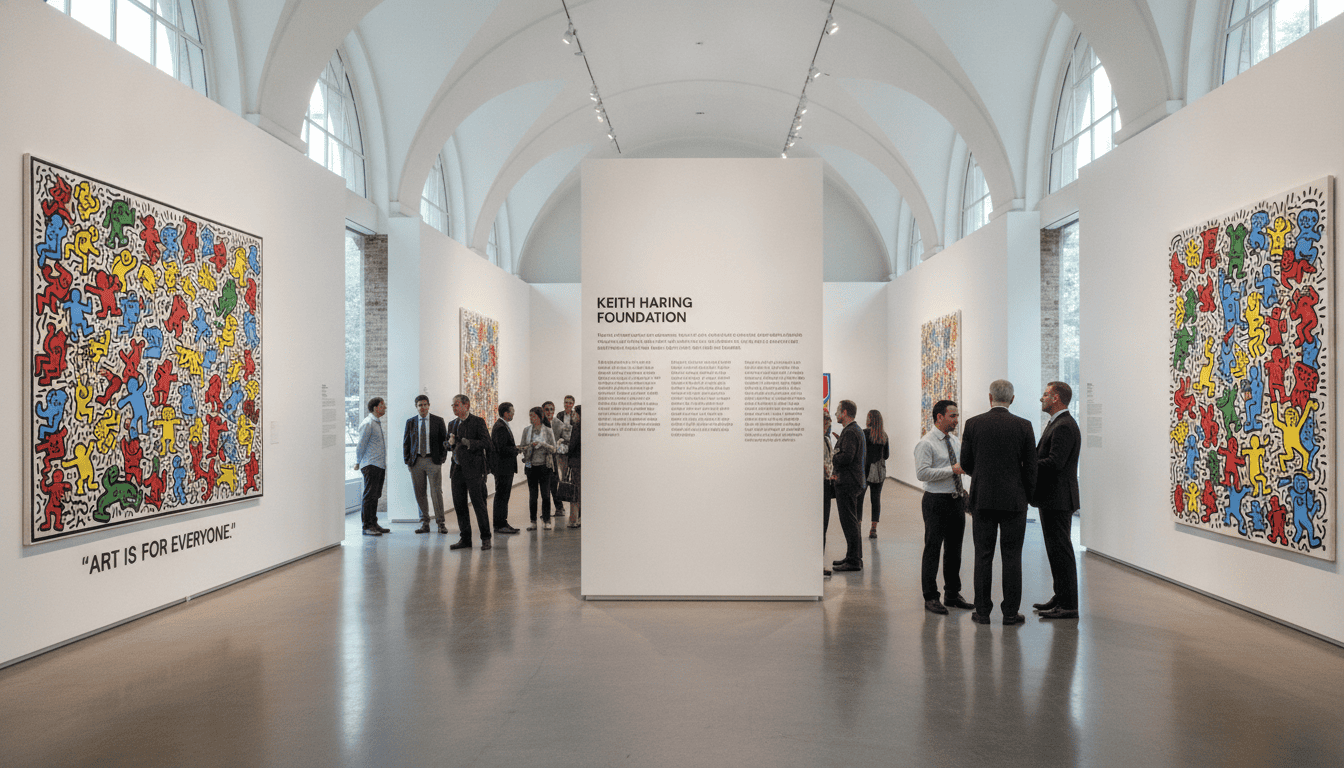
In 1989, Keith Haring established the Keith Haring Foundation while facing AIDS’s progression. The foundation embodied his commitment to supporting charitable causes and assisting organizations serving children and those affected by HIV/AIDS. This institutional structure ensured his philanthropic work would continue beyond his lifetime.
Foundation Mission and Structure
The Keith Haring Foundation’s mission reflects Haring’s dual priorities: supporting AIDS-related organizations and children’s programs. The foundation provides funding to institutions doing direct service work rather than merely raising awareness. This practical focus ensures resources reach communities most needing support.
Foundation grants support diverse organizations worldwide. AIDS service providers receive funding for treatment access, prevention education, and patient advocacy. Children’s organizations get support for arts education, hospital programs, and disadvantaged youth initiatives. The grant portfolio reflects Haring’s belief in art’s transformative potential and health equity’s importance.
Managing Artistic Legacy
Beyond philanthropy, the foundation manages Haring’s artistic estate. This responsibility includes authenticating works, licensing imagery for appropriate commercial uses, and organizing exhibitions. The foundation balances making work accessible with protecting against exploitation or misrepresentation.
Authentication services prevent forgeries from circulating. The foundation maintains comprehensive archives documenting Haring’s output. Experts examine questionable works, providing certificates of authenticity for genuine pieces. This service protects collectors while preserving market integrity.
Exhibition organization keeps Haring’s work visible internationally. The foundation loans pieces to museums and curates traveling retrospectives. These exhibitions introduce new generations to his art while providing scholarly context. Major shows have appeared in museums across Europe, Asia, and the Americas.
Educational Programs and Outreach
The foundation supports educational initiatives teaching young people about Haring’s work and its social context. Curriculum materials help teachers incorporate his art into lessons addressing activism, AIDS history, and 1980s culture. These resources make his work pedagogically useful beyond aesthetic appreciation.
Scholarships and residencies provide opportunities for emerging artists. The foundation funds programs helping artists develop practices engaged with social issues. This support continues Haring’s commitment to nurturing next-generation creative voices addressing community needs.
Preservation and Archival Work
The foundation maintains extensive archives of Haring’s work, including finished pieces, sketches, correspondence, and documentation. These materials support scholarly research while preserving historical record. Digitization projects make archives accessible to global researchers.
Conservation efforts protect surviving public murals and other vulnerable works. The foundation funds restoration when appropriate and advocates for preserving important pieces threatened by development or neglect. This stewardship honors Haring’s public art legacy.
Funding Priorities and Impact
Since its founding, the Keith Haring Foundation has distributed millions in grants. Recipient organizations span the globe, reflecting Haring’s international consciousness. Funding priorities evolve with changing needs while maintaining focus on HIV/AIDS and children’s welfare.
Recent grants address contemporary challenges including LGBTQ+ youth homelessness, HIV prevention in developing nations, and arts access for disabled children. The foundation adapts to current conditions rather than remaining locked in 1980s contexts, asking what Haring would support if alive today.
The foundation operates transparently, publishing annual reports detailing grant recipients and financial operations. This accountability reflects Haring’s values around honesty and direct communication. Supporters can verify that resources genuinely reach intended beneficiaries.
Continuing Commercial Ventures
The foundation manages licensing arrangements allowing Haring’s imagery to appear on products and collaborations. Revenue generated supports charitable grants. This structure maintains Haring’s model of converting commercial success into social support.
Licensing decisions balance accessibility with appropriateness. The foundation rejects proposals misaligning with Haring’s values or cheapening his work. Approved collaborations often include charitable components, with portions of proceeds supporting relevant causes.
Advocacy and Public Policy
Beyond grantmaking, the foundation engages in advocacy around issues Haring championed. Representatives participate in policy discussions about arts funding, AIDS treatment access, and LGBTQ+ rights. This advocacy work extends Haring’s activist legacy into contemporary political contexts.
The foundation provides funding to organizations doing direct service work rather than merely raising awareness. This practical focus ensures resources reach communities most needing support, honoring Haring’s commitment to tangible community benefit over symbolic gestures.
Major Exhibitions and Museum Collections
Keith Haring’s work entered major museum collections during his lifetime—unusual recognition for an artist who hadn’t yet reached forty. His death in 1990 prompted reassessment of his contributions, leading to significant retrospectives that cemented his art-historical importance.
Lifetime Exhibitions and Recognition
Haring’s first solo museum exhibition occurred in 1982 at the Tony Shafrazi Gallery in New York. This show established him as gallery-worthy artist beyond his subway work. Critics responded positively, recognizing conceptual sophistication beneath accessible surfaces.
International exhibitions followed rapidly. European museums showed particular interest, mounting solo exhibitions in Amsterdam, London, Paris, and other cities. Japanese institutions also embraced his work enthusiastically. This global reception validated his belief in visual language’s universal communicability.
Group exhibitions placed him alongside established artists like Warhol and Basquiat. These institutional associations legitimized street art within museum contexts. Curators recognized that excluding graffiti-influenced work meant ignoring significant contemporary developments.
Posthumous Retrospectives
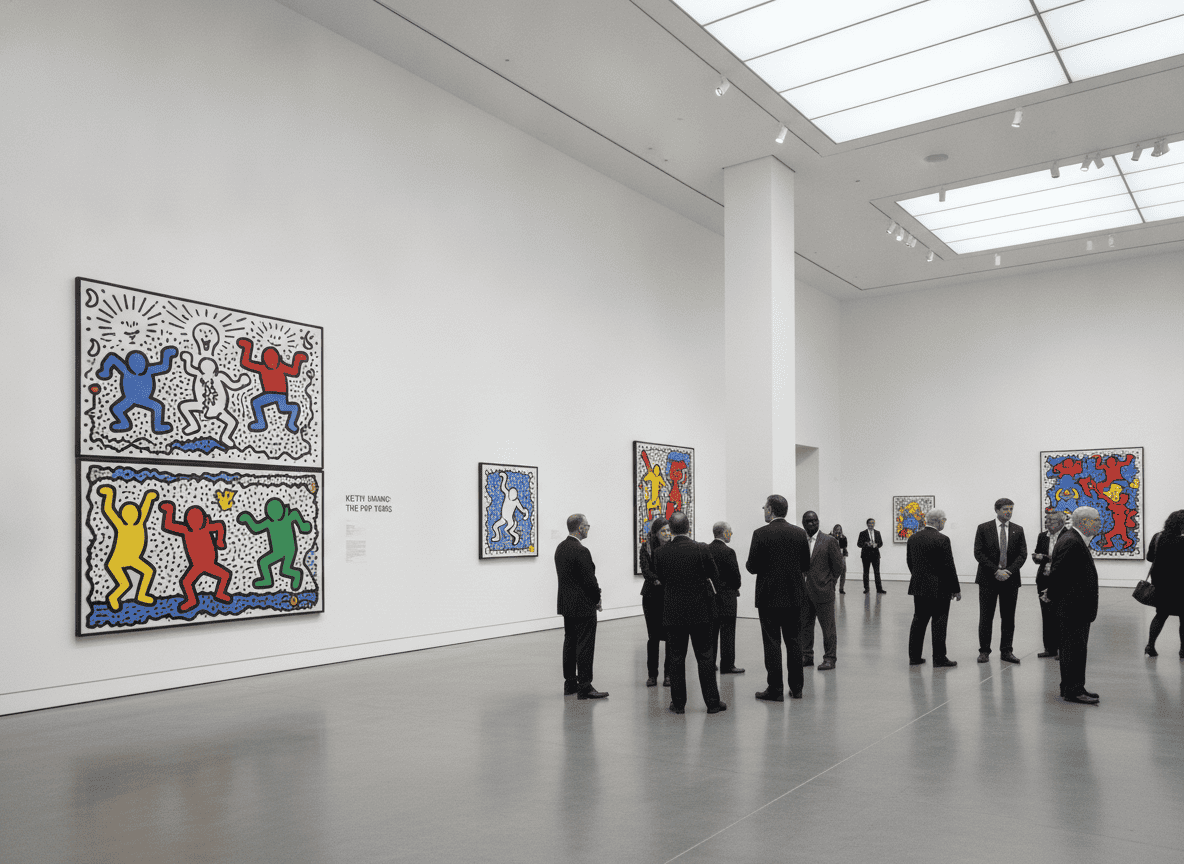
Major retrospectives following Haring’s death demonstrated his lasting significance. The Whitney Museum of American Art organized a comprehensive survey in 1997, examining his entire career through paintings, drawings, and ephemera. This exhibition toured internationally, reaching audiences in Europe, Asia, and Australia.
The Brooklyn Museum’s 2012 exhibition focused on his political work, emphasizing how activism permeated his practice. This thematic approach revealed coherence between commercial ventures and social engagement, challenging simplified narratives about Haring as either sellout or saint.
Permanent Collections
Haring’s work resides in over fifty museum collections worldwide. The Museum of Modern Art in New York holds significant pieces including major paintings and drawings. The Whitney Museum of American Art maintains extensive holdings documenting various career phases.
International collections include Centre Pompidou in Paris, Stedelijk Museum in Amsterdam, and Ludwig Museum in Cologne. These institutions recognized Haring’s importance to contemporary art history, acquiring works representing different periods and media.
Smaller museums focused on street art and urban culture feature Haring prominently. These institutions provide context showing how his work emerged from specific cultural moments while transcending original circumstances.
Recent Exhibitions and Continued Interest
Twenty-first century exhibitions demonstrate sustained scholarly and public interest. The de Young Museum in San Francisco mounted a major retrospective in 2014. Tate Liverpool organized a career survey in 2019, introducing British audiences to comprehensive overview of his production.
Recent shows often emphasize Haring’s activism and political engagement. Curators recognize how his social commitments shaped aesthetic choices. Exhibitions contextualize work within 1980s political climate, helping younger audiences understand historical urgency.
Thematic exhibitions explore specific aspects like his AIDS activism or collaborations. These focused approaches allow deep investigation of particular interests while revealing work’s multifaceted nature. The scholarship demonstrates Haring’s practice rewards sustained analysis beyond initial visual impact.
Educational Programming
Museums mounting Haring exhibitions typically develop extensive educational programming. Workshops invite participants to create art using his techniques. Lectures and panel discussions explore his historical context and ongoing relevance.
School groups receive special programming introducing young people to Haring’s work. Educators value how his accessible style and social content create entry points for discussing complex topics. Students respond enthusiastically, connecting his energy with contemporary concerns.
Digital Exhibitions and Virtual Access
Recent years have seen digital exhibitions expanding access beyond physical institutions. Online platforms present Haring retrospectives viewable globally. These virtual exhibitions include high-resolution images, contextual information, and sometimes interactive elements.
The Keith Haring Foundation website maintains virtual gallery showing representative works. This resource serves students, researchers, and general public unable to visit physical exhibitions. Digital access continues Haring’s democratic mission through contemporary technology.
Final Years and Death at Age 31
Keith Haring received his AIDS diagnosis in 1988. The disease had already claimed numerous friends and collaborators. Rather than withdrawing from public life, he intensified his work, creating prolifically while advocating for AIDS awareness and research funding.
Response to Diagnosis
Haring addressed his diagnosis publicly, refusing the silence and shame often surrounding AIDS. This openness served multiple purposes—it destigmatized the disease, encouraged others to get tested, and used his platform to demand political action on the epidemic.
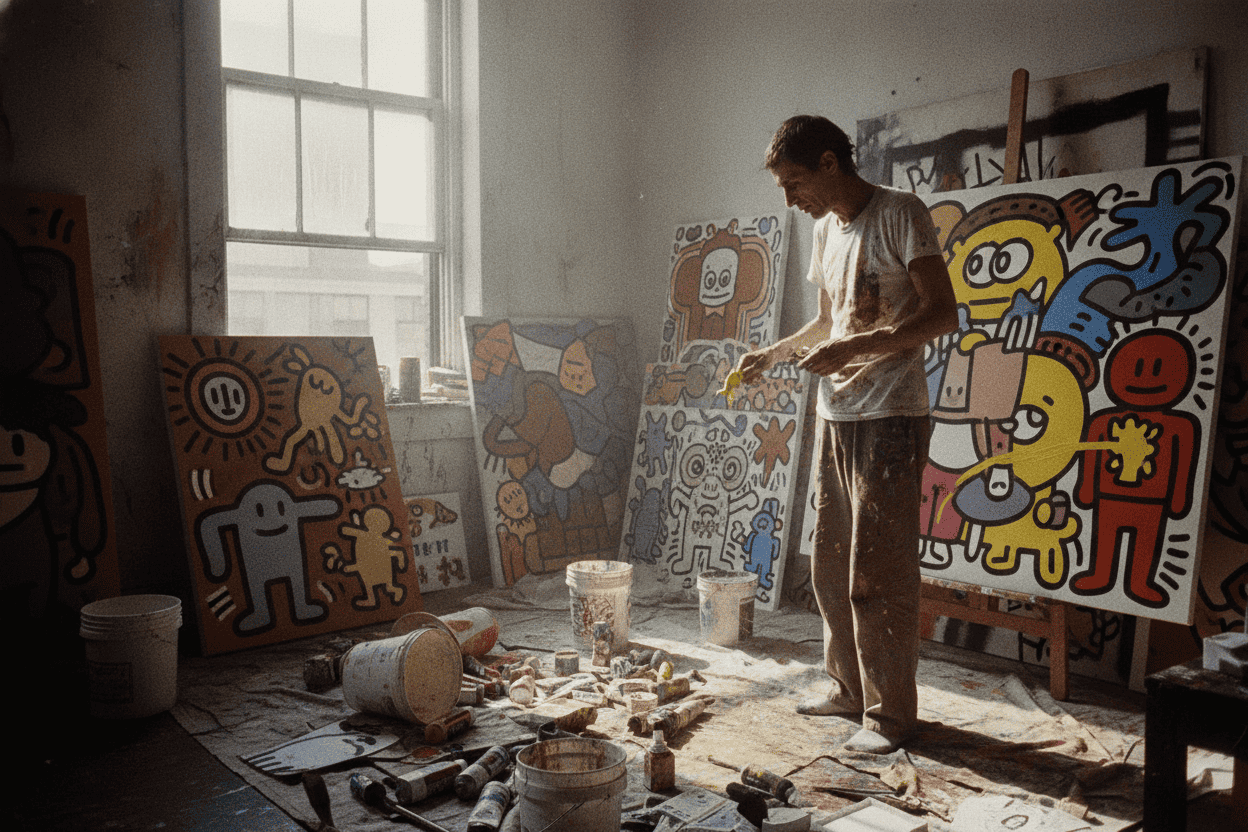
His artistic production increased despite declining health. He created some of his most powerful political work during this period. The urgency was palpable—he recognized limited time and maximized remaining productivity. Each project carried added weight, potentially representing final opportunities to address specific issues.
Continued Activism and Creation
The final two years saw prolific output across media. He completed major murals, created paintings and drawings, and designed public awareness materials. The work maintained his characteristic energy despite physical deterioration. Stylistically, pieces from this period show no decline—if anything, they demonstrate enhanced urgency.
AIDS activism consumed significant energy. He created educational posters, donated artwork to fundraising efforts, and participated in public campaigns demanding government action. The work was deeply personal—he fought for his own survival alongside community protection.
Establishing Lasting Institutions
Creating the Keith Haring Foundation in 1989 represented practical planning for legacy continuation. He couldn’t control lifespan but could structure how his work and wealth would support causes after death. The foundation’s establishment showed remarkable presence of mind amid crisis.
He organized his archives, recognizing their historical value. Documentation efforts increased. He gave interviews discussing his career and philosophy. These actions demonstrated awareness of mortality coupled with determination to shape how he’d be remembered and understood.
Relationships and Support Systems
Haring’s friends provided crucial support during final years. Fellow artists, activists, and collaborators maintained contact. The community he’d built throughout his career reciprocated with presence during decline. These relationships sustained him emotionally when facing death.
His family reconnected during illness. Earlier tensions around his sexuality had strained relationships, but serious illness prompted reconciliation. His parents and siblings provided support, accepting him fully in ways that brought healing before the end.
Death and Immediate Aftermath
Keith Haring died on February 16, 1990, at age thirty-one. AIDS-related complications caused his death at New York Hospital. The news devastated the art world and communities he’d served. Memorial tributes appeared globally, testifying to his widespread impact.
Major newspapers published extensive obituaries. Art publications devoted special issues to his career. The attention reflected genuine loss—people recognized they’d witnessed extraordinary talent cut short. The timing was particularly cruel—Haring had just reached artistic maturity when death intervened.
Memorial services drew thousands. Artists, activists, celebrities, and ordinary people whose lives his work had touched gathered to honor him. The diverse attendees reflected his boundary-crossing practice—he’d built communities across social divisions.
Legacy Preservation Efforts
The Keith Haring Foundation immediately assumed stewardship responsibilities. They organized exhibitions, published catalogs, and managed estate affairs. This institutional structure prevented the chaos that sometimes follows artists’ deaths, ensuring orderly legacy management.
Friends and collaborators shared memories in publications and documentaries. These firsthand accounts preserved personal perspectives on Haring’s character and working methods. The testimonials revealed someone genuinely committed to his stated values, not merely performing progressive politics.
“Keith’s death felt like losing possibility itself. He represented this infectious belief that art could actually change things, that creativity and activism weren’t separate pursuits but the same urgent work. When he died, we lost not just an artist but a model for how to live and create with total commitment.”
Cultural Mourning and Memorialization
Haring’s death occurred during the AIDS epidemic’s peak devastation. His passing symbolized the broader tragedy consuming creative communities. Memorial murals appeared in cities worldwide. Other artists created tribute works. The collective mourning extended beyond personal loss to acknowledge systemic failure in addressing the crisis.
His youth at death—thirty-one—amplified the tragedy. Speculation about what he might have created with more time became inevitable. The compressed productivity of his short career made the loss particularly poignant. A decade of work had yielded impact typically requiring lifetimes.
Legacy and Influence on Contemporary Art and Culture
Keith Haring’s influence extends far beyond his decade of major productivity. His innovations in public art, artist entrepreneurship, and socially engaged practice shaped subsequent generations. Contemporary art and popular culture continue reflecting his impact more than three decades after his death.
Street Art and Public Practice
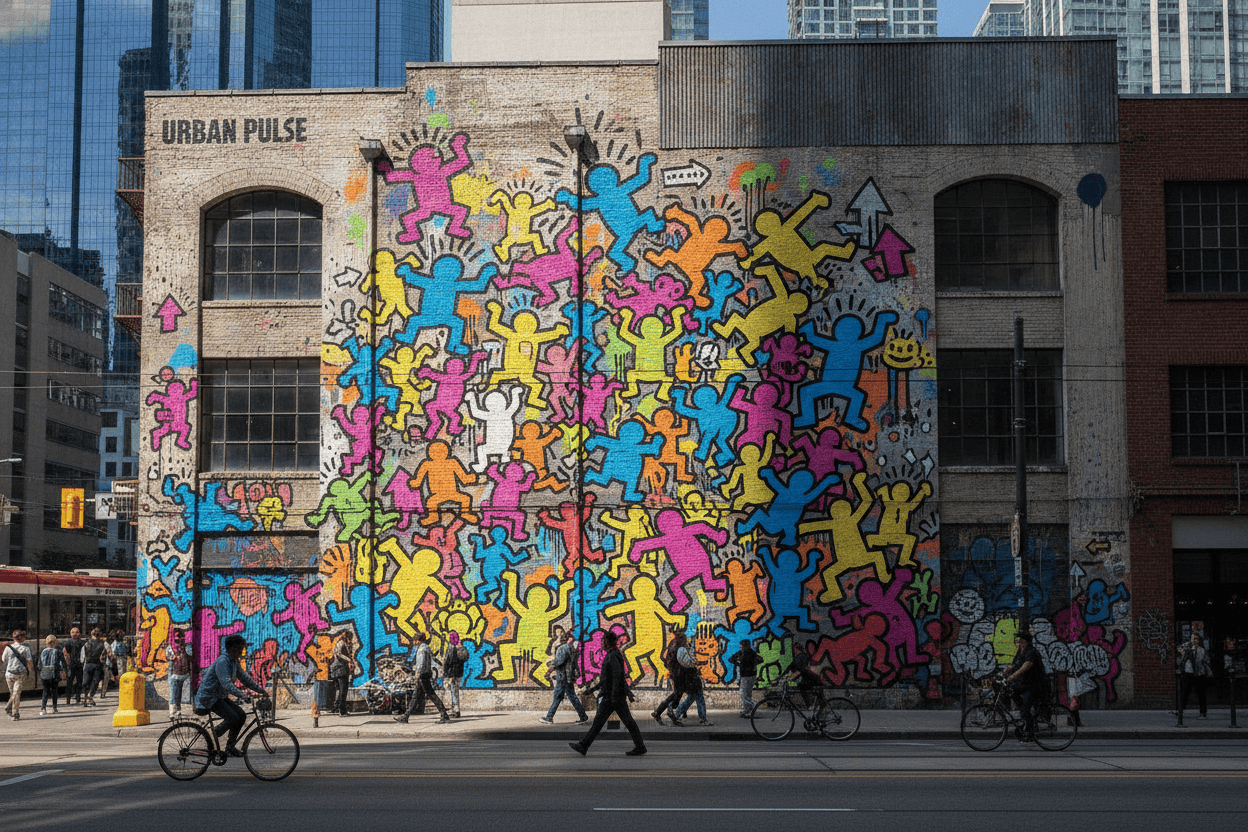
Haring helped legitimize street art and graffiti within institutional art contexts. His success demonstrated that work originating outside galleries could achieve museum recognition without compromising integrity. This pathway influenced countless artists pursuing public practice.
Contemporary street artists acknowledge Haring as pioneer. Banksy, Shepard Fairey, and others building careers on public interventions follow models Haring established. His demonstration that street work could generate gallery opportunities while maintaining public engagement created viable career templates.
The accessibility principle he championed remains influential. Artists creating work for public consumption rather than exclusive collectors cite his example. The idea that art should reach broad audiences beyond institutional gatekeepers now seems obvious, partly because Haring normalized this thinking.
His comfort with commercial applications freed subsequent artists from false dichotomies between artistic integrity and commercial engagement. Contemporary artists collaborate with brands, create limited edition products, and operate retail ventures without apologizing. Haring’s precedent legitimized these activities as valid artistic strategies.
Activist Art and Social Engagement
Haring modeled how artists could address urgent issues without sacrificing aesthetic sophistication. His work proved that political art needn’t be didactic or visually compromised. Contemporary socially engaged artists reference his integration of activism with compelling imagery.
AIDS activism in art owes enormous debt to Haring’s example. He demonstrated how personal experience could fuel powerful public statements. Artists addressing health crises, LGBTQ+ rights, and social justice issues follow pathways he helped establish.
The Gran Fury collective and other activist art groups active during Haring’s lifetime shared his commitment to accessible political communication. His influence on these movements was direct—they admired his work and adopted similar strategies of bold graphics serving urgent messages.
Visual Language and Iconography
Haring’s symbolic vocabulary entered global visual culture. The radiant baby appears in contexts far beyond fine art—advertising, tattoos, merchandise, and street graphics all incorporate this figure. Few twentieth-century artists created imagery achieving such widespread recognition.
His linear style influenced graphic design, illustration, and commercial art. The bold outlines and simplified forms he favored became design trends extending beyond art world boundaries. Contemporary designers cite his work when developing projects requiring immediate visual communication.
Animation and motion graphics absorbed Haring’s aesthetic. His figures’ inherent suggestion of movement translates naturally to animated media. Music videos, commercial animation, and digital art frequently reference his bouncing, dancing characters.
LGBTQ+ Representation and Visibility
As openly gay artist achieving mainstream success, Haring provided visibility during era when homophobia remained socially acceptable. His refusal to hide sexuality while building major career inspired LGBTQ+ artists pursuing similar paths without closeting themselves for commercial acceptance.
His work addressing queer themes and AIDS contributed to LGBTQ+ cultural memory. Younger generations discovering his art encounter representation of 1980s gay experience. This historical documentation preserves community memory while inspiring contemporary queer artists.
Preserve Haring’s Revolutionary Legacy in Your Collection
Keith Haring transformed how we understand art’s role in society—proving that powerful imagery could educate, activate, and inspire while remaining accessible to everyone. Our studio honors his legacy by bridging the gap between unaffordable original artworks (Haring pieces now sell for hundreds of thousands at auction) and disposable mass-market posters that disrespect his craftsmanship. We create gallery-quality reproductions using museum-grade Giclée technology, archival materials with 100+ year longevity, and meticulous color matching that honors every bold line and vibrant hue. These aren’t decorations—they’re investment-grade pieces celebrating an artist who believed art belongs in homes, not just behind velvet ropes.
Discuss custom murals and large-format projects:
Fashion and Design Influence
Haring’s collaborations with fashion designers during his lifetime established precedent for art-fashion partnerships. Contemporary designers frequently license his imagery or reference his aesthetic. The Uniqlo collaborations featuring his work introduced new generations to his style through accessible clothing.
Skateboard culture embraced Haring early and maintains connection. Numerous skateboard deck designs feature his imagery. This association links him to youth culture and street sports—appropriate given his public art origins.
Educational Impact
Art education curricula worldwide include Haring when teaching contemporary art. His accessible style and clear social commitments make him effective for introducing students to ideas about art’s social functions. Teachers use his work to discuss activism, AIDS history, and 1980s culture.
Museums use Haring exhibitions as entry points for young audiences. Children respond to his energetic figures and bold colors. This accessibility serves museums seeking to build future audiences by making contemporary art approachable rather than intimidating.
Market Value and Collectibility
Haring’s market has strengthened significantly since his death. Major paintings sell for millions at auction. Even prints and drawings command substantial prices. This commercial success validates his artistic importance through market mechanisms.
The market growth reflects genuine scarcity—his compressed career limited total output. Demand exceeds supply, driving prices upward. Collectors recognize both aesthetic value and art-historical significance, viewing Haring works as sound investments alongside cultural treasures.
Criticism and Reassessment
Not all legacy assessment has been positive. Some critics argue his commercial ventures compromised artistic integrity. Others claim his work lacks formal sophistication compared to contemporaries. These critiques generate productive debates about art’s purposes and value measures.
Scholarly reassessment continues evolving. Recent exhibitions and publications explore previously underexamined aspects of his practice. The critical conversation remains active, suggesting his work rewards sustained analysis rather than representing historical curiosity.
Global Recognition and Cultural Penetration
Haring achieved rare status—global name recognition extending beyond art audiences. People unfamiliar with contemporary art history often recognize his imagery. This cultural penetration validates his democratic aspirations while complicating legacy preservation.
His work appears in unexpected contexts worldwide. From Tokyo street fashion to São Paulo murals, his influence circles the globe. This international presence reflects both his conscious internationalism and the visual language’s genuine cross-cultural communicability.
Conclusion: The Enduring Revolution of Keith Haring
Keith Haring fundamentally altered contemporary art’s trajectory during his brief but explosive career. He demonstrated that serious artistic practice could embrace accessibility without sacrificing sophistication. His work bridged supposed opposites—street and gallery, commercial and political, playful and urgent.
The democratic vision animating his practice remains revolutionary. Haring refused to accept that art should remain exclusive domain of wealthy collectors and institutional gatekeepers. He created work for everyone, distributed through every available channel from subway walls to retail stores to museum galleries.
His integration of activism with aesthetics provided model for socially engaged art. He proved that addressing urgent political issues didn’t require abandoning visual pleasure or formal innovation. The bold graphics and joyful energy coexisted with serious content addressing AIDS, apartheid, nuclear weapons, and social justice.
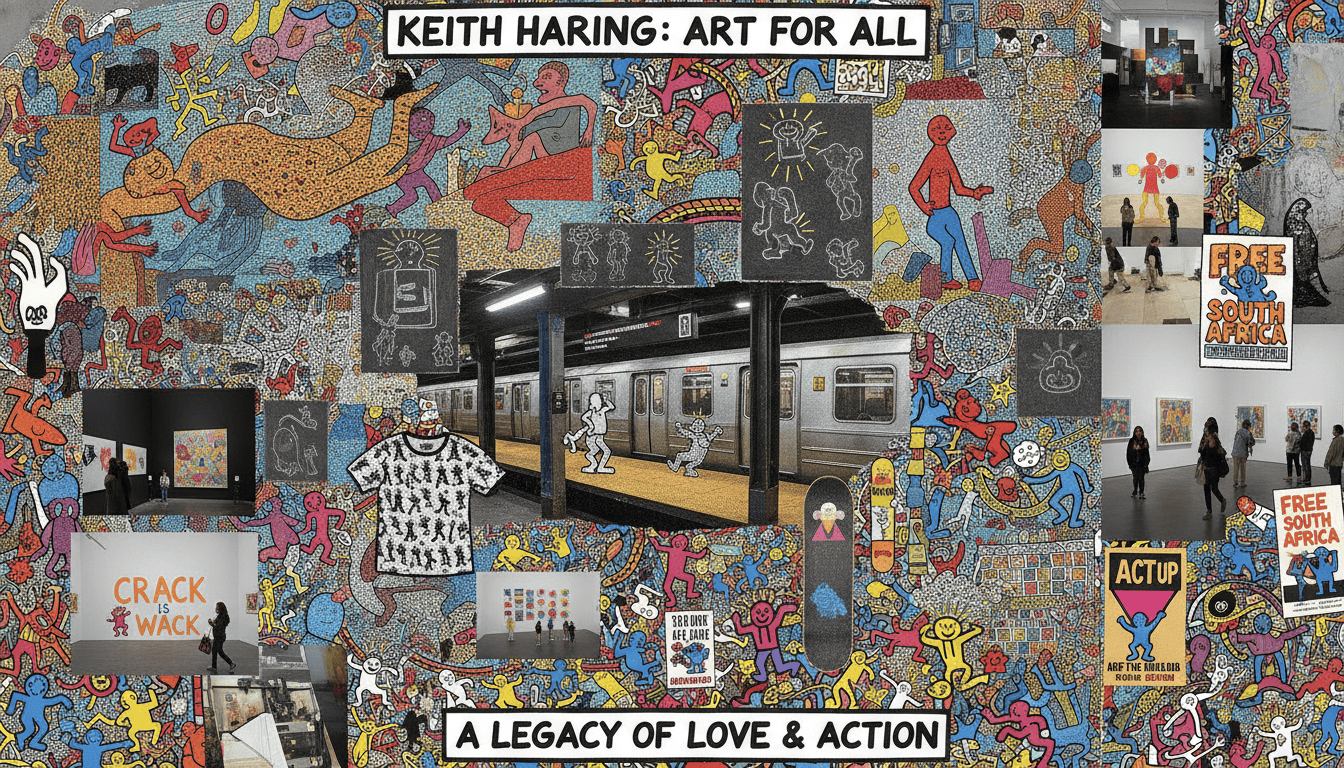
The personal cost of his commitments was immense. AIDS claimed him at thirty-one, cutting short extraordinary creative potential. Yet his compressed productivity generated lasting impact. A single decade of major work yielded achievements many artists pursue across full lifetimes.
Contemporary culture continues absorbing his influence. Street artists, graphic designers, activists, and commercial creators all reference his innovations. The visual vocabulary he developed remains current, speaking to new generations encountering urgent issues through his accessible symbolic language.
His legacy extends beyond individual artworks to include institutional structures supporting ongoing work. The Keith Haring Foundation sustains his philanthropic commitments, funding AIDS organizations and children’s programs. This structure ensures his values continue generating tangible community benefits decades after his death.
Understanding Haring requires recognizing how he collapsed false boundaries. He was simultaneously street artist and museum darling, political activist and commercial success, serious creator and playful entertainer. These apparent contradictions resolved into coherent practice guided by consistent principles.
The democratizing impulse driving his career feels increasingly relevant. As contemporary art markets reach unprecedented price levels, questions about accessibility gain urgency. Haring’s model—creating work for everyone while maintaining artistic standards—offers alternative to exclusive luxury goods masquerading as cultural production.
His optimism about art’s potential to communicate across differences and inspire positive change may seem naïve. Yet this optimism fueled remarkable achievements. He reached millions, influenced culture, and supported crucial causes. The earnest belief in art’s power generated concrete results.
Future generations will continue discovering Keith Haring through multiple entry points. Some encounter his work in museums, others through street art, fashion collaborations, or digital reproductions. This multiplicity of access points fulfills his vision—art reaching people through whatever channels prove most effective.
The line work remains instantly recognizable. The radiant baby, barking dogs, and dancing figures constitute visual language transcending their 1980s origins. These symbols carry meanings that adapt to new contexts while maintaining core associations with energy, joy, and resistance.
Keith Haring proved that one person armed with creativity, conviction, and white chalk could impact global culture. His revolution wasn’t violent—it was visual, joyful, and insistent. The bold lines he drew continue radiating outward, inspiring new expressions of democratic art committed to accessibility, activism, and uncompromising energy.
His story reminds us that artistic careers needn’t span decades to achieve significance. Intensity and focus can accomplish more than extended time. Haring lived and created with urgency appropriate to his historical moment, leaving legacy that outlives his brief years.
The question he posed remains relevant: Who is art for? His answer—everyone—challenges ongoing exclusivity in creative fields. By maintaining this democratic commitment while producing work of undeniable quality and impact, Keith Haring charted pathway still worth following. The radiant lines continue glowing, pointing toward possibilities when art serves humanity rather than mere markets or institutions.
